

20-Second Summary
The Kiwi Bird Egg is about 20% of the entire body weight of a female kiwi. So it will not be wrong to say that a female kiwi mother carries a baby that weighs 30 to 40 pounds at birth when compared to a human pregnancy.
When we look at the entire world of birds, the kiwi egg is an unusual reproductive cycle. From being developed as an egg to being hatched as a fully developed chick, whose incubation involves the role of their father more than their mother, the enormous eggs of kiwi birds are New Zealand’s most iconic flightless bird eggs, which are six times larger than the eggs of any other bird of the same size as a kiwi.
This blog about the kiwi bird egg is finally going to answer all of your questions about the life cycle of this egg and its origin.
Kiwi Bird Egg: Why It’s the World’s Most Extraordinary Egg
Let us officially figure out the life cycle behind the extraordinary lifecycle of a Kiwi bird egg.

Introduction: The Egg That Defies Biology
When it comes to the biology of eggs
- The ostrich that lays the world’s largest egg still has the egg that comprises only 2% of its mother’s body weight
- The eggs of hens are also about 2 to 3 percent of their mother’s body weight
- And if we compare the kiwi bird egg size to a human child at birth, it is also only 5% of a human mother.
This makes the kiwi bird egg one of a kind that defies biology by being 20% of its mother’s body weight.
The Anatomy of a Kiwi Egg: What Makes It Different?
There are three factors that make a kiwi bird egg different, including:
- Size and weight
- Large egg yolk
- Shell thickness and durability

Size and Weight Breakdown
A typical brown kiwi egg weighs between 400 to 450 grams, equal to the weight of a smartphone.
- The egg of a kiwi bird has a huge egg yolk with nutrition that helps it grow completely inside the egg, and this huge egg phenomenon is what makes the kiwi so special among all bird species.
- Each kiwi chick is developed inside one of the most nutrient-rich environments possible in the avian world.
Internal Structure: The Large External Yolk Sac
Most bird eggs are about 35 to 40% yolk; the rest is egg white. But kiwi eggs are about 65% yolk.
The purpose of this large external yolk sac is that it can sustain the young kiwi chick for the first week of life after hatching, even without any help from the parents.
The kiwi chicks, once hatched, are called precocial, which means that they have a large yolk sac full of nutrients that sustains the chick for up to 10 days , and it may also last for two and a half week, after it is hatched, and then they learn to find their own food.
When a chick of a kiwi bird hatches, it is fully feathered, with its eyes fully open, and able to walk immediately without any help from its parents.
This large external yolk sac makes the kiwi chicks just like the miniature version of their parents, and adult kiwis, who can feed on their own without assistance from their parents.
Shell Thickness and Durability
The female kiwi bird provides calcium requirements for producing a thick shell that is enough for holding a huge chick inside it, depleting its body energy, enabling the female kiwi to just lay the egg, and then the male kiwi takes the responsibility of the incubation period of the egg.
Kiwi Bird Species: Which Lay the Largest Eggs?
Not all kiwis lay eggs of the exact same size. There are five bird species of kiwi, and they vary slightly. Let’s break down each one by its egg eight, percentage body weight, and the places where they are found.

| Kiwi Species | Egg Size in Grams | Percent of Body Weight | Where They Live | Conservation Notes |
| North Island Brown Kiwi (Apteryx mantelli) | 420 to 450 | About 18 to 20 percent | Forests of the North Island, such as Waipoua Forest | The most common kiwi has more than 30000 birds. Males sit on the egg for 70 to 80 days. |
| Great Spotted Kiwi (Apteryx maxima) | 380 to 420 | About 14 to 16 percent | Alpine and beech forests in the South Island | Listed as vulnerable. Lives in high mountain areas. |
| Little Spotted Kiwi (Apteryx owenii) | 140 to 170 | About 12 to 14 percent | Predator-free islands like Tiritiri Matangi and Kapiti | Critically endangered. All living birds come from a small rescued group. |
| Southern Brown Kiwi or Tokoeka (Apteryx australis) | 400 to 430 | About 18 to 20 percent | Stewart Island and Fiordland | Includes rare groups such as the Haast tokoeka with fewer than 300 birds. |
| Rowi or Okarito Brown Kiwi (Apteryx rowi) | About 400 to 430 | About 18 to 20 percent | Okarito forest on the South Island West Coast | One of the rarest kiwi species with fewer than 500 birds. Conservation work focuses on nest and predator protection. |
Why Does the Female Kiwi Lay Such a Massive Egg? The Two Competing Theories
There has been a lot of debate about why kiwi females lay such large eggs, and researchers have come up with two theories, of which one is being more accepted.
Theory 1: The “Growing Egg” Hypothesis
This idea says kiwis were always small birds.
- Over millions of years, their eggs slowly became bigger and bigger.
- Bigger eggs make stronger chicks that can survive better.
- New Zealand once had no predators, so this helped chicks stay safe.
The problem is that if eggs kept growing but the bird stayed small, the mother would struggle too much to lay them, and because of this, many scientists think this idea does not fully explain the giant egg.
Theory 2: The “Shrinking Ancestor” Hypothesis
This is the idea most scientists now support.
- It says the kiwi’s ancient ancestor was a much bigger bird, maybe as big as a cassowary.
- Over millions of years, the ancestor’s body became smaller to fit New Zealand’s forests.
- The egg size did not shrink as fast as the body.
- This slow change is called evolutionary lag.
Fossils, including a bird called Proapteryx, show that kiwi ancestors got smaller while still producing large eggs, explaining why modern kiwis are chicken-sized but lay eggs that are far too large for their body size.
The Female Kiwi’s Breeding Cycle: A Year-Long Ordeal

Different types of female kiwis have different breeding season timelines. The reproductive cycle varies significantly among kiwi species. Below, we have given a timeline of the breeding season for each type of female kiwi bird.
| Kiwi Species | Peak Laying Period | Eggs Per Clutch | Clutches Per Year | Male Incubates Alone |
| North Island Brown Kiwi | June to November | 1-2 eggs | 1-2 clutches | Yes |
| Great Spotted Kiwi | August to October | 1 egg | 1 clutch | Yes |
| Little Spotted Kiwi | Year-round variable | 1 egg | 1-2 clutches | Both parents* |
| Southern Brown Kiwi | Year-round flexible | 1-2 eggs | 1-2 clutches | Both parents (Stewart Island)* |
| Okarito Brown Kiwi | May to December | 1 egg | 1 clutch | Yes |
Some of the subspecies show different parenting patterns, with both parents participating in incubation rather than just the father.
The Physical Toll on Females
When a kiwi bird starts developing an egg, it gains a huge amount of weight due to the egg, which can go up to 30 to 50% of its own body weight.
- This makes it tough for her to move quickly.
- Many female kiwis respond to this extra weight by wading into streams and water, where water supports the weight of their bodies, easing their stress.
- Since she gives up most of the calcium from her body to create a durable and thick egg layer, she loses more of her strength and needs three to six weeks to recover from her weakness.
During this recovery period, she’s eating heavily to rebuild her strength and calcium stores.
Male Incubation: The 70-80 Day Marathon
The male incubation process is what makes the reproductive cycle of a kiwi bird egg unique and unusual. After the female lays the egg, what happens next depends entirely on which kiwi species we’re talking about.

In some kiwi species, the male kiwi incubates the egg 100% of the time. The female doesn’t help at all. She doesn’t turn the egg, she doesn’t keep it warm, she doesn’t guard it. The male does everything.
However, in other kiwi species, both parents share incubation duties equally or partially.
| Kiwi Species | Who Incubates | Incubation Days | Male Behavior | Parental Support |
| North Island Brown Kiwi | Male only | 75-85 days | 15-minute feeding breaks | A female is independent after laying |
| Little Spotted Kiwi | Male only | 63-76 days | ~21 hours/day in burrow | Female independent; both guard chick post-hatch |
| Great Spotted Kiwi | Both parents share | 75-85 days | Shared equally; female guards during male feeding | Both parents incubate; the male does day shifts |
| Southern Brown Kiwi | Both parents share | 75-85 days | Shared duties (Stewart Island helps raise chicks for years) | Both parents and some family groups stay together |
| Okarito Brown Kiwi | Male only | 75-80 days | Dedicated to burrow | A female is independent after laying |
The male kiwi (or both parents in some species) maintains a constant temperature of 37 to 38 degrees Celsius (about 99 to 100 degrees Fahrenheit) inside the burrow. He also maintains humidity at around 70 to 80%, which is crucial for the developing chick’s survival.
Burrow Environment and Nesting for Kiwi Bird Egg Hatching
Kiwi nests are usually built in a burrow on the forest floor, often lined with soil and leaf litter that helps keep the egg warm and steady.
- The male kiwi does not always dig a fresh burrow. He may use hollow logs, old rabbit or rat tunnels, or root systems if they keep temperature changes low.
- Great spotted kiwi take burrow building seriously. They make long tunnel systems with more than one exit, unlike the simple burrows of the brown kiwi and the little spotted kiwi.
- The male or both parents guard the burrow entrance closely because introduced predators can easily find kiwi eggs.
A safe burrow helps the kiwi bird egg stay at the right temperature and gives newly hatched chicks a better chance to survive in the wild.
Incubation Challenges for Male Kiwi Birds

The male incubates the egg for about 70 to 80 days, which is one of the longest incubation periods of any bird in the world.
- While incubating, the male kiwi faces predators like stoats and rats. These mammal predators hunt eggs laid in low burrows.
- Moisture is a constant problem. Too much causes mold, and too little dries out the egg. The male kiwi balances this while sitting on the egg for about 21 hours a day.
- The male often loses 15 to 20 percent of his body weight because he can only leave for short feeding trips. In some species, he leaves for only 15 minutes.
- Climate events such as frost, drought, or flooding can destroy kiwi nests and kill the developing kiwi chicks.
- In the great spotted kiwi, rowi, and tokoeka, both parents share incubation. The female guards while the male incubates, and she takes over when he leaves to find food.
- In the North Island, the brown kiwi and the little spotted kiwi, the male incubates alone, making the workload heavier.
- Their huge egg contains a large external yolk sac, which helps the chick hatch as a miniature version of an adult kiwi with strong legs, kiwi feathers, and a long beak.
Kiwi chicks use their legs and feet to break open their egg shells, unlike other birds that have an egg tooth to break their shells. They are extremely vulnerable after hatching, especially in places without predator-free islands or conservation help like Operation Nest Egg.
Hatching Process: The Legs and Feet Struggle to Break Open the Shell (Day-by-Day Timeline)
After 70 to 80 days of constant incubation, the moment of hatching finally arrives.
Pre-Hatching: Days 70-79
The chick spends most of their incubation time turning into a chick’s body by absorbing the yolk sac filled with nutrients.
- The chick’s lungs are developing and expanding into an air cell at the broad end of the egg.
- The chick becomes more active, moving around inside the shell.
The Hatch: Days 80-82
Unlike most birds, kiwi chicks don’t have an egg tooth. So, they use their strong legs and feet to kick and push their way out of the shell.
This process is called zipping, which can take up to three days.
The kiwi chick will spend up to three days pushing and kicking its way out. It’s exhausting work for the tiny chick, and most chicks rest frequently during this process.
Before zipping, there are two earlier stages known as the Internal pipping and the external pipping.
- During internal pipping, the chick breaks through the inner membrane to reach the edge of the egg.
- And then during the external pipping, the chick breaks the outer shell, making a hole in it.
After the second stage, the chick creates a circular opening at the top of the egg, just like unzipping a zip, by pecking in a way across the shell.
Immediate Post-Hatch (Hours 1-24)
When the newly hatched chicks emerge, they look like an adult kiwi.
- Its feathers are wet and matted from inside the egg
- In a few hours, the feathers dry and fluff up.
- The chick’s eyes are already open and functional.
- Its legs are strong enough to walk.
- The chick is already alert and ready to interact with its environment.
The chick typically remains in the burrow for the first few days, still sustained by the yolk reserves that came with it from the egg.
Newly Hatched Kiwi Chicks: Born Fully Equipped
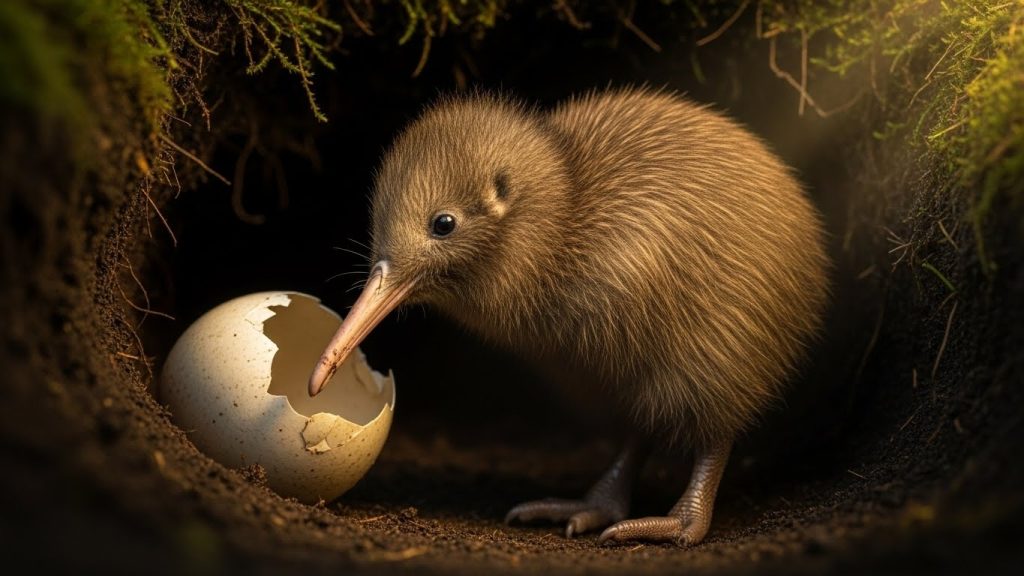
Newly hatched kiwi chicks look like adult kiwis.
- They have fluffy feathers, functional and open eyes, strong legs to walk, and a good sense of smell.
- For the first few days, they stay in the nesting burrow and live on a rich yolk sac for required nutrients.
- After about a week, they start looking for insects in the soil and leaf litter with their long beaks, under their father’s guidance.
These young kwis are very vulnerable, and the introduced predators in New Zealand make their survival very difficult.
Survival Rates: How Conservation Changes the Odds
In the wild, very few kiwi chicks survive because introduced predators like rats and stoats hunt them.
Operation Nest Egg helps by taking kiwi eggs to safe places, hatching them, and raising the chicks until they are strong. This makes survival much higher.
Predator-free islands like Tiritiri Matangi and Kapiti give young kiwis a safe home, helping kiwi populations grow.
Comparative Table: Kiwi Eggs vs. The World’s Other Notable Eggs
Let’s compare kiwi with other notable eggs in the world, to see how they really are unusual and unique:
| Species | Egg Weight | Mother Weight | % of Body | Incubation Days | Chick Type |
| Brown Kiwi | 450g | 2.5kg | 20% | 75 | Precocial |
| Ostrich | 1,400g | 70kg | 2% | 42 | Precocial |
| Emu | 700g | 30kg | 2.3% | 56 | Precocial |
| Cassowary | 600g | 45kg | 1.3% | 49 | Precocial |
| Great Spotted Kiwi | 400g | 2.8kg | 14% | 75 | Precocial |
| Chicken | 55g | 2kg | 2.7% | 21 | Altricial |
| Penguin | 150g | 4kg | 3.7% | 65 | Altricial |
| Human | 3,500g | 70kg | 5% | 280 | Altricial |
The kiwi lays a huge egg compared to its body size, one of the toughest challenges for any bird.
Kiwi’s New Zealand Context: Why These Birds Matter

The kiwi bird is a species only found in New Zealand, and is known as its national symbol.
- These flightless birds evolved without land predators, allowing them to develop huge eggs and unique hunting habits.
- Human arrival brought introduced predators like rats, dogs, and stoats, and cleared forests, reducing kiwi numbers from millions to about 68,000 today.
- Most kiwis now live in protected forest reserves on the North Island and South Island.
- Predator-free islands play a key role in helping kiwi populations survive and breed.
- Conservation programs, such as Operation Nest Egg, support kiwi survival and recovery.
Why Female Kiwis Must Lay Eggs This Way: The Evolutionary Lock-In
Many people are questioning why evolution did not work for the kiwi bird egg, and why the female has not evolved into producing smaller and more eggs over time.
- To answer this, evolution has not changed this because for millions of years, kiwis lived safely in big numbers, and even if individually producing fewer eggs, they were still making many together, but with human arrival, it was a very sudden change for them to adapt.
- Kiwis haven’t had time to evolve smaller eggs or faster reproduction rates.
- That’s why programs like Operation Nest Egg are so important to keep the eggs and chicks safe, so more kiwis can survive.
Final Remarks
The kiwi bird egg is incredible and unique when compared to the development and hatching process of other birds’ eggs. It shows how adaptable and unique kiwis are.
Although humans brought new predators to the habitat of kiwi birds and wiped out millions of them, Operation Nest Egg and predator-free islands are helping them survive.
The kiwi birds not only lay a big egg, but the egg hatches into a fully grown adult, like a kiwi chick that learns to adapt to its environment within 7 to 10 days of its birth, and this species has been living in New Zealand for about 70 million years now.
To know more interesting facts about Kiwis and other birds, keep visiting Pets Guide Info, as we keep updating about birds regularly.
Frequently Asked Questions
How many eggs does a female kiwi lay per year?
A female kiwi typically lays 1 to 2 eggs per breeding season. Under some ideal conditions, a female might lay three eggs, but this is uncommon.
Why is the kiwi egg so large compared to the mother’s body size?
The kiwi egg is about 20% of the female kiwi’s body weight. It retained its size from its larger ancestors, based on its restricted evolution due to humans and predators invading its habitat, making them extinct and less available to reproduce and evolve. This big egg helps kiwi chicks hatch fully grown and ready to survive on their own in New Zealand.
What happens immediately after a kiwi chick hatches?
Newly hatched kiwi chicks are born fully feathered with open eyes and can walk. They use their strong feet and legs to break the shell. For the first week, the yolk sac feeds them, then they start exploring with their father to find insects and learn to survive.
What is Operation Nest Egg, and how does it improve kiwi chick survival?
Operation Nest Egg is a program that collects kiwi eggs from the wild habitat, and hatches them in safe facilities like Auckland Zoo, and raises the chicks in predator-free areas before releasing them. Wild chicks survive only 5 to 10%, but this program increases survival to 65 to 80% before release and 30 to 50% after.
Why are newly hatched kiwi chicks so much more developed than other bird chicks?
Kiwi chicks hatch fully feathered with open eyes and strong legs, nourished by a large yolk, providing them enough nutrients to develop inside the egg, requiring just few days to adapt their habitat and survive from day one without least support from their parents, which is not the case for other species that require time to develop feathers, open eyes, and fetch food with parents help only.